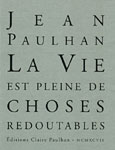
La vie est pleine de choses redoutables
Jean PaulhanIt was certainly not in the nature, nor in the spirit of Jean Paulhan (1884-1968) to keep a personal or literary diary: “You are barely starting and you are already stumbling,” he noted when speaking to himself on December 15, 1926. “It already seems to you that a diary cannot be kept and essentially in the disposition in which you are - that the truth is not what you said.” However, he left behind him notebooks, notebooks and sheets, written at various crucial or painful periods of his life: these texts, which he had partially reread shortly before his death, are brought together here in their chronological entirety. As much as his correspondence currently being published shows the man at work, the friend in action, the critic on the alert, the literary director in authority, these intimate writings, which go from 1904 to the last years of Jean Paulhan, evoke the dreamy sensitivity of the young philosophy student, the fascination for the Malagasy people, the violent anxieties of the fiancé, the husband and the father, the refuge of the adulterous soldier in illness, the doubts of the writer and the linguist, the “progress in love quite slow” and quite late, the deep friendships for men – Fénéon, Groethuysen, Muselli – of whom he speaks as if about himself, finally the memories of his childhood in Nîmes:
“From the age of ten, I believe,” he wrote in 1946, “I wanted to become old. At what age, I asked myself, do we stop requiring a man to study, to have a job and earn a living, to have a wife and children, to chase women, to drink in cafes, and the rest. I have gotten older and I see that I was not wrong. It has only been perhaps five or six years since I felt free, and, yes, precisely happy: with a well-founded happiness (while my childhood joys, rather rare, but very vivid, always seemed inexplicable to me). Grounded, I just mean close to me, easy to remember. I don’t mean natural.”
At the heart of these collected autobiographical texts, where Jean Paulhan hides as much as he reveals himself, is one of the keys to his personality – a key linked to a deep secret, suffered and contained: “As assiduously, as wisely as Breton goes mad,” he wrote on October 22, 1925, “I will have applied myself to ceasing to be so all my life.”
Text established and annotated by Claire Paulhan. “For Memory” collection.
First edition by Seghers, in August 1989. Reissued by Verdier, in 1995. Reissued, in 1997, under a new gray filled cover, by Éditions Claire Paulhan.
Notebook of photographs n. & b. Bibliography.
17 x 22 cm. 360 pages. ISBN: 2-912222-01-X.
Public sale price: €27
Editeur : Claire Paulhan