Guillaume de Tarde
Towards the end of the 19th century, in a small suburban garden, two 10-year-old children, Jean and Guillaume, become acquainted because their fathers, Frédéric Paulhan and Gabriel de Tarde, have maintained a philosophical correspondence for a long time. This meeting will be followed by seventy-four years of deep friendship.
However, ten years later, everything should separate the two teenagers: social origins, living conditions, political tendencies...
Jean Paulhan, only son, lives with his family, surrounded by a brilliant and restless swarm of young foreign students. Indeed, his mother ensures, at the cost of exhausting work, the material life of her family, by running a family boarding house.
As for Guillaume de Tarde, although his family owned a castle in the Dordogne, a sign of relative wealth, he lost his father, a magistrate in Sarlat, at a very young age.
However, the two young people share everything, at least a lot: the lack of money, the race for private lessons, the outings, the association with young Russian anarchists (feminine), not without fleeting jealousies, the enthusiasms, the hopes, the discouragements, the courses and even the writing of endless philosophy homework submitted to the Sorbonne under their double signature.
Resources
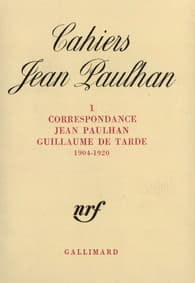
Correspondance : Guillaume de Tarde & Jean Paulhan, 1904-1920
Mention of Guillaume de Tarde in a text by Jean Paulhan :
- Jean Paulhan citoyen de Jacques Debû-Bridel
Bibliography of texts published in the NRF
The texts below, published in La Nouvelle Revue Française, are grouped into four main sets: texts by Guillaume de Tarde, notes and columns by the author, texts about the author, and, when available, translations by the author.
Notes by Guillaume de Tarde
These texts by Guillaume de Tarde may include reading notes, mood notes, performance reviews, miscellaneous pieces, or previously unpublished texts. They appeared in NRF sections such as Chronique des romans, L'air du mois, Le temps comme il passe, etc., or in tribute issues.
- La Révolution Roosevelt, par Georges Boris (Éditions de la N. R. F.), 1934-09-01, Notes : économie sociale
Chronological distribution of texts published in the NRF (1908-1968)
This chart shows the chronological distribution of texts across the four categories defined above: Texts, Notes, Translations, and Texts about the author.